Proksee News
Assembly Variant Finder identifies variants in a project genome relative to a closely related reference genome. It combines variant calling, predicted effects, and interactive sequence browsing in one report.
- Find single-nucleotide variants, insertions, and deletions in assembled bacterial genomes.
- Locate changes on a reference sequence and interpret them using its gene annotation.
- Search and filter calls, inspect every predicted consequence, and browse the complete reference contigs.
- Download variant files, consequence tables, callable regions, and figures for further analysis.
The two genomes have distinct roles. The project genome is the sample under investigation, such as a newly sequenced isolate. The reference genome is the baseline against which its variants are called. Variant positions, reference alleles, gene annotations, and the sequence in the viewer all belong to the reference. An insertion represents sequence added in the project relative to the reference; a deletion represents reference sequence absent from the project.
The tool aligns the project to the reference with minimap2, described in Heng Li's paper Minimap2: pairwise alignment for nucleotide sequences, and calls variants with paftools.js. An annotated reference in GenBank format, or reference FASTA plus GFF3, enables SnpEff predictions against the reference's genes and transcripts. The SnpEff method is described by Cingolani and colleagues. A reference without annotation still supports variant calling and sequence browsing.
When optional automatic preset selection is enabled, the tool uses an initial alignment to choose the alignment setting and records its choice in the report. Explicit manual presets remain available.
Poorly aligned regions can leave differences between genomes undetected. The report therefore shows how much of the reference could be assessed and explains any coverage or similarity limitations. If too little sequence can be compared, or the genomes exceed the supported divergence threshold, it provides an assessment without a final variant list.
The example below compares Escherichia coli K-12 W3110 as the project (AP009048.1) with MG1655 as the reference (NC_000913.3). The interactive report presents the variants in a table, with one row for each difference and columns for its reference position, type, gene, and primary predicted consequence. Selecting a variant's row updates the details panel beside the table. Its Overview tab shows the sequence change and supporting alignment evidence; the Consequences tab provides the full set of gene and transcript predictions for that variant.
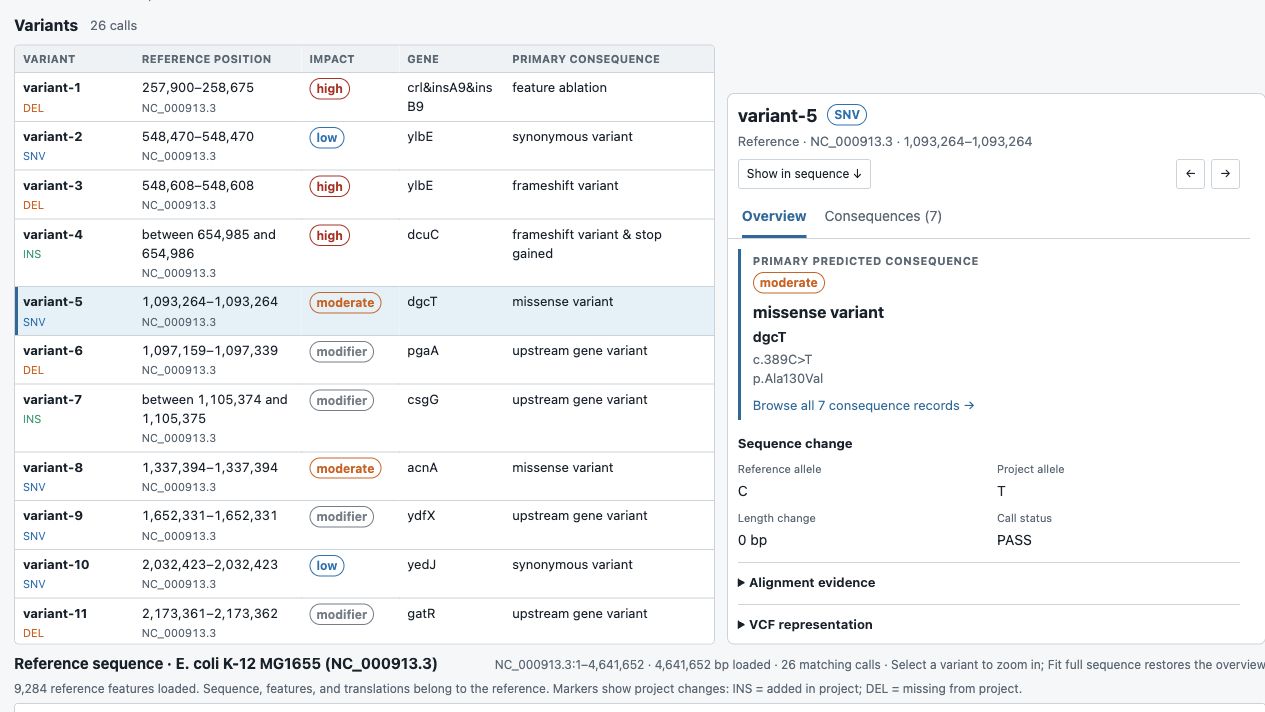
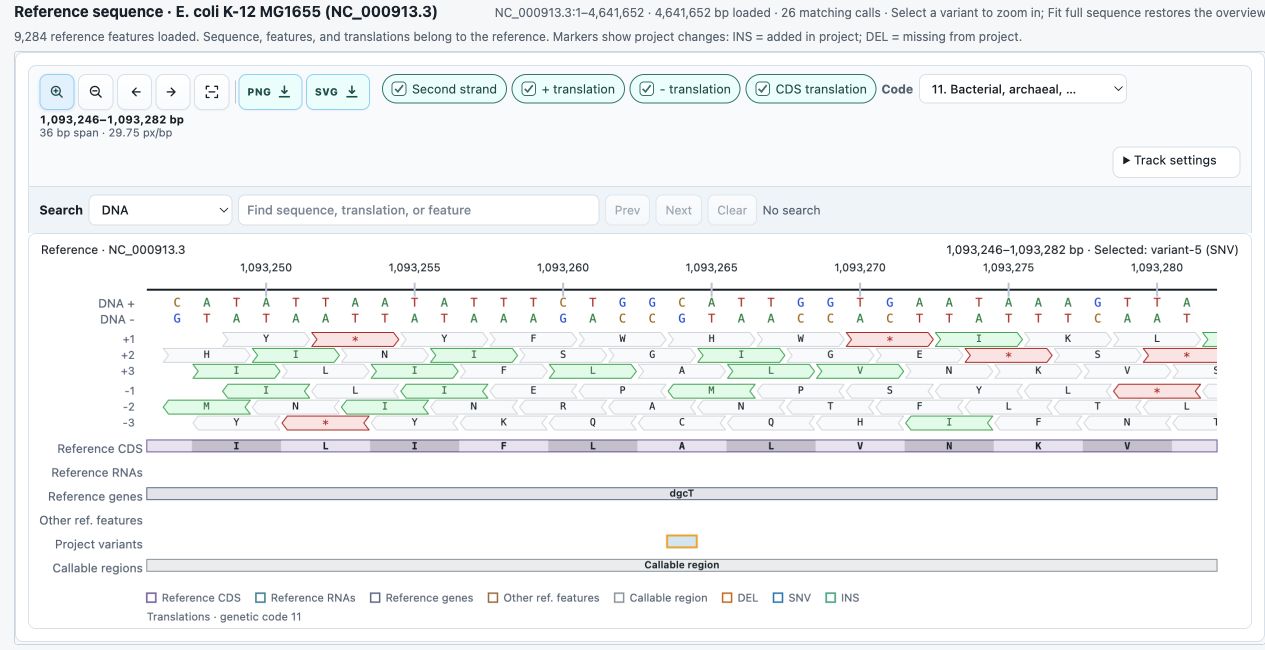
The interactive report supports searching the variant table by gene, predicted consequence, or reference position, and filtering by variant type or predicted impact. For a closer look, Show in sequence opens the selected variant's surroundings in a viewer derived from Sequence Manipulation Suite 3. The compact viewer places DNA above translations and annotation tracks. At close zoom, the CDS translation option displays amino-acid letters inside annotated coding regions, with each letter aligned to its reference codon. Individual DNA bases and translations can be inspected, the sequence can be searched, and the view can be zoomed out to explore larger regions or the whole reference contig. The viewer and details panel stay linked as different variants are selected. Feature hover cards expose annotation notes and other qualifiers, including pseudogene flags, to help explain features whose names alone are not informative.
The analysis also produces downloadable files for follow-up work:
- Variant VCF files record each change's reference position and reference and project alleles for use with other variant-analysis tools.
- Variant tables in TSV, downloadable from the interactive report, list positions, sequence changes, and supporting details for spreadsheet review or analysis scripts.
- Consequence tables in TSV and JSON, downloadable from the report when reference annotation is supplied, link each matching variant to its gene and transcript annotations and predicted DNA and protein changes. They include every reported consequence for each matching variant.
- Callable-region BED files identify the reference intervals that met the alignment and coverage requirements for variant calling. These intervals distinguish assessed regions from those where differences could have gone undetected.
Report table downloads follow the current display filters and include matching calls beyond the visible page. To export the entire callset, select All calls and All contigs, and clear the other filters. The complete VCF retains both PASS and non-PASS calls. In compact output, VCF and BED downloads are compressed and supplied with matching indexes; tables remain available through the report, while separate calls JSON and duplicate table files are omitted.
The current sequence view can be exported as a PNG or SVG figure. The downloadable HTML report supports offline browsing of the results and reference sequence.